




Prevent Cross-Tenant RAG Leaks with Cedarling
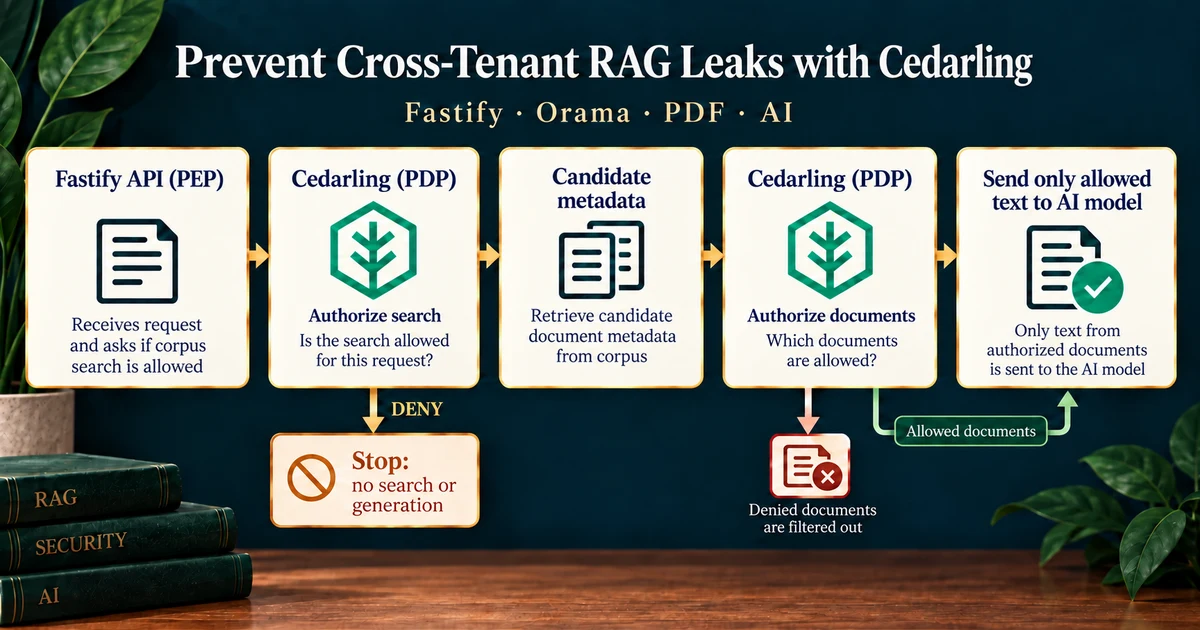
Authorize corpus search and each candidate document before protected text reaches an AI model.
On this page
Project source and prerequisites
- Complete P2 project (external site) and starting checkpoint (external site).
- Install Docker with Compose, or Node.js 24.21+ within 24.x and pnpm 10.17.1. Live retrieval also needs Voyage AI and OpenRouter API keys and consumes provider quota; use synthetic queries only.
- Local HTTP and the bundled IdP are for learning only. Production requires HTTPS and a configured OIDC/OAuth issuer, such as Jans Auth (external site), Gluu, Auth0, or Okta.
- I prepared these steps on Ubuntu 24.04+. Native project checks also run in CI on macOS and Windows. If a platform-specific step fails, open an issue (external site).
- New to Cedarling? Read the short introduction when you need it.
- Keep the official Cedar policy syntax (external site) and Cedar schema syntax (external site) references handy for the policy-store steps.
Paths below are relative to p2-tenantrag/ unless stated otherwise. Generated
answers and retrieval rankings can vary; the authorization decisions and cited
evidence are what we will verify.
What are we going to protect?

Ada has a confidential-document grant, Leo can use public Tenant A evidence, and Mallory belongs to Tenant B.
A support assistant can give a useful answer and still disclose information to the wrong person. The problem starts before the answer: which documents were sent to the model?
I'll trace that evidence path with you, then put a decision before each place where protected text can enter it.
P2 is a Node.js API that searches synthetic PDFs and generates answers. Voyage creates embeddings, Orama searches the vector index, and OpenRouter provides generation. There is no browser application. We will protect two operations: searching a tenant's corpus and loading each candidate document.
- Ada belongs to Tenant A and may read its public documents and the confidential document explicitly shared with her.1
- Leo belongs to Tenant A but may read only its public documents.
- Mallory belongs to Tenant B and must not retrieve Tenant A's evidence.
“Public” means public within that tenant, not available to every caller.
Caller -- access token + question --> Node.js API (PEP)
                                          |
                current corpus facts --> Cedarling: SearchCorpus
                                          |
                                        ALLOW
                                          v
                                Voyage query embedding
                                          |
                                Orama candidate metadata
                                          |
              current document facts --> Cedarling: RetrieveDocument batch
                                          |
                                 keep allowed documents
                                          v
                                  load selected text
                                          |
                                     OpenRouter
                                          |
                                    answer + citations
Cedarling is the policy decision point, or PDP. The retrieval service is the policy enforcement point, or PEP: it controls whether execution reaches protected text and generation. The model does not—and must never—decide access.
Reproduce the leak before adding Cedarling
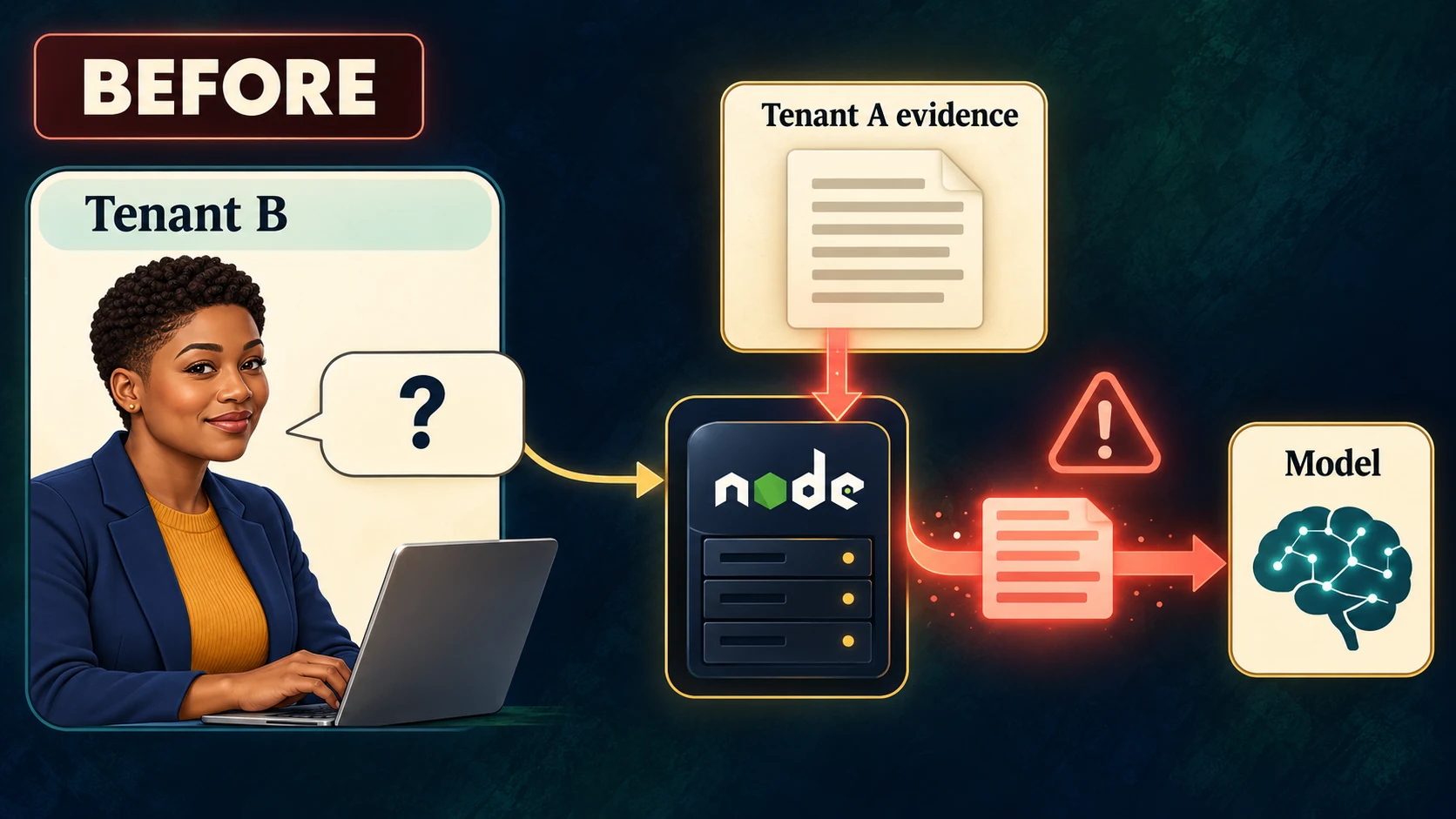
In the baseline, authentication alone does not stop Mallory's cross-tenant retrieval.
Start an isolated baseline
Use a separate checkout so the exercise does not change your existing data:
git clone https://github.com/GluuFederation/cedarling-tutorials.git cedarling-p2
cd cedarling-p2
git switch --detach 21b0832be4b31271320df992d04e9d97667d0e38
cd p2-tenantrag
Use Node.js 24.21 or newer within 24.x and pnpm 10.17.1 for host commands.
Put P2_VOYAGE_API_KEY and P2_OPENROUTER_API_KEY in the ignored project .env.
Keep their values out of source control and recordings.
For Docker, start the API and its IdP together:
docker compose up --buildFor native baseline startup, use two terminals. In the first:
pnpm --dir ../shared/identity-provider install --frozen-lockfile
pnpm --dir ../shared/identity-provider build
pnpm install --frozen-lockfile
pnpm run setup
node --env-file=.local/idp/.env ../shared/identity-provider/dist/main.js
In the second, from p2-tenantrag/, run pnpm dev. Use one startup method at a
time. The API is http://localhost:17002; the IdP is http://localhost:18002.
With Docker, also install the project's host dependencies for the authentication
CLI using pnpm install --frozen-lockfile.
pnpm run setup builds the Orama corpus index from the synthetic PDFs as part
of native setup; the first Docker startup builds it automatically. No separate
corpus:reset is needed for a fresh checkout. Preparing the corpus sends PDF
chunks to Voyage, and native setup also checks generation. Retrieval calls
consume provider quota. Use fictional
questions: the embedding provider receives your question, and generation receives
the question and selected evidence. The baseline does not yet filter that evidence
by the caller's permissions.
Ask for another tenant's evidence
In a free terminal, authenticate as Mallory:
pnpm auth malloryOpen the displayed verification URL. The development IdP usually prefills
mallory; enter it if the field is empty. Use any non-empty password, such as
cedarling-is-awesome, then approve access. Copy the printed token into your
HTTP client's bearer-token field. I use Postman (external site),
but any client that can send HTTP requests works:
POST http://localhost:17002/v1/retrievals
Authorization: Bearer <access-token>
Content-Type: application/json

{
  "corpusId": "tenant-a-support",
  "query": "How should customer retrieval data be isolated?",
  "limit": 3
}
The baseline authenticates Mallory but permits the two retrieval boundaries. It
can load Tenant A text and send it to the model for her. Inspect returned citations,
not just the answer. The baseline test/retrieval.test.ts demonstrates the leak
with fixed candidates and a test generation client, independently of providers.
Capture the request and any returned Tenant A citations. A provider error proves
neither a leak nor a denial. Stop the baseline before applying the integration.
For Docker, use Ctrl+C, then docker compose down; keep its data volume.
Prepare trusted retrieval facts
The starting service already authenticates callers, resolves corpus metadata, searches candidate IDs, and loads document text. Its two marked authorization seams are before query embedding and before loading candidate text, but both currently omit per-caller authorization.2
Before writing a rule about confidential readers, add the missing server-owned facts. Map Ada and Leo to Tenant A and Mallory to Tenant B; give only Ada a grant for the confidential Aster document. Carry that grant through the fixture type, PDF metadata, and repository without taking it from the HTTP request:3
// src/rag/fixtures.ts (confidential Aster document)
confidentialReaderSubjects: ["ada"],
Keep the existing corpus-indexing and provider setup. No document text should be loaded to determine a grant; the next steps authorize from metadata first.
Decide which evidence each caller may use
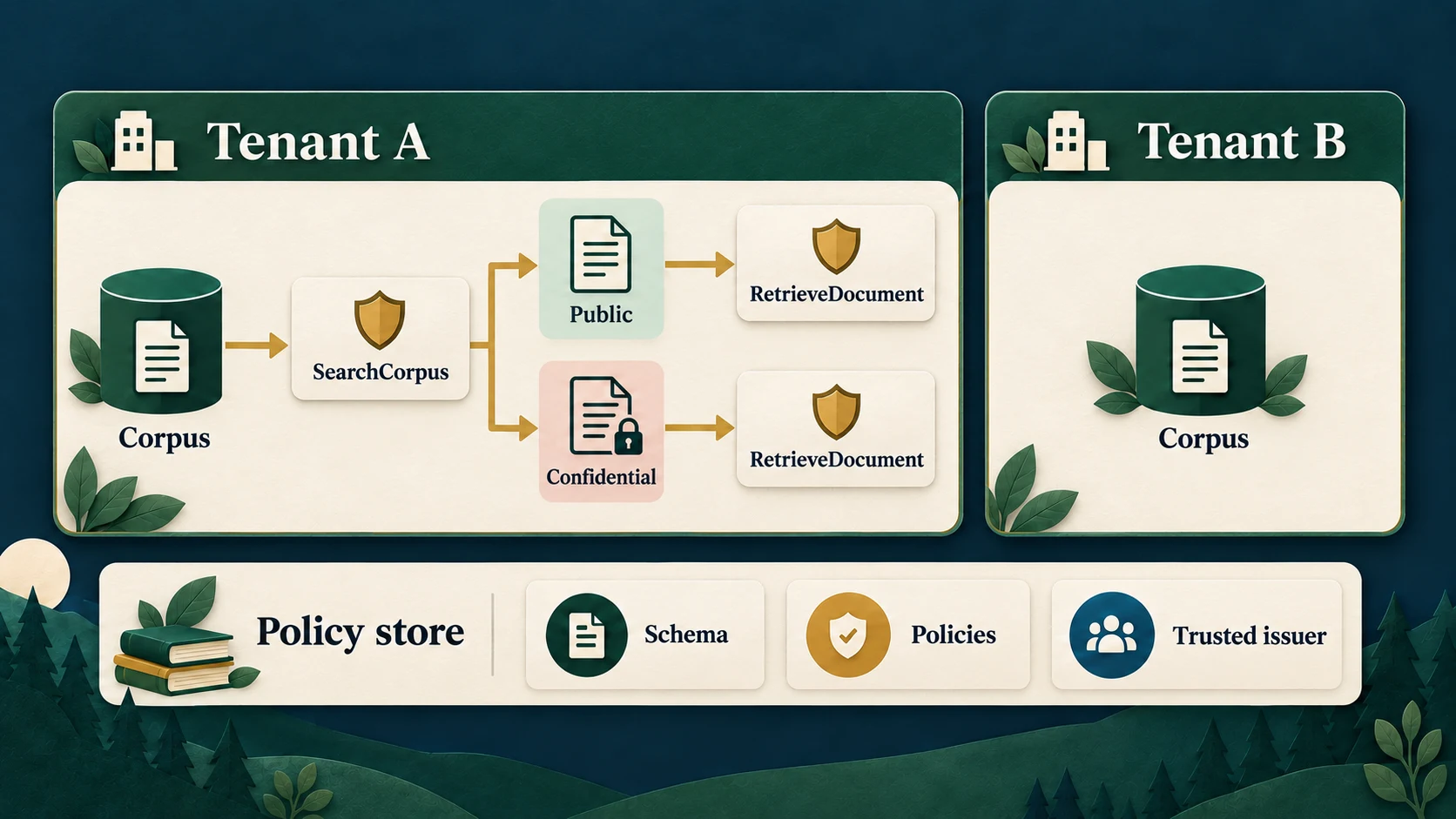
The corpus rule gates search; the document rule gates which candidate text can be loaded.
Design a readable policy store
Use the directory-based policy-store format (external site):
policy-store/
  metadata.json
  schema.cedarschema
  policies/
    server-access.cedar
  trusted-issuers/
    tutorial-idp.json
Create these four source files from the completed policy store.4
The metadata identifies this store and version 1.0.0. The schema defines the
request vocabulary. Both rules live in one policy file with distinct @id
annotations. Current document facts arrive in requests, so default entities and
templates are unnecessary.
| Design question | P2 answer |
|---|---|
| What represents identity? | Signed access token mapped as P2TenantRAG::Access_token |
| Which issuer and audience are trusted? | P2 IdP at http://localhost:18002; audience http://localhost:17002/api |
| What operations exist? | RAG::Action::"SearchCorpus" and RAG::Action::"RetrieveDocument" |
| What does search target? | RAG::Corpus with corpus and tenant IDs |
| What does retrieval target? | RAG::Document with corpus, tenant, classification, and confidential readers |
| Which context is required? | Server boundary, authenticated subject, current user tenant, selected corpus ID |
| What permits access? | Required token binding and scope, matching tenant/corpus, and document access |
| What must deny? | Another tenant, missing scope, wrong identity binding, or confidential evidence without a grant |
The schema includes the token and issuer types Cedarling builds during JWT
processing. RAG::Any satisfies the action's principal-type declaration; it is
not another application user. Multi-issuer requests carry identity in tokens.
In trusted-issuers/tutorial-idp.json, set openid_configuration_endpoint to
http://localhost:18002/.well-known/openid-configuration. The trusted
access_token mapping uses entity_type_name: "P2TenantRAG::Access_token",
token_id: "jti", and required claims iss, sub, aud, jti, exp, and
scope.
Write the document rule
This complete policy from policies/server-access.cedar binds verified token
claims to current application facts:
// policy-store/policies/server-access.cedar
@id("server-retrieve-authorized-document")
permit(
  principal,
  action == RAG::Action::"RetrieveDocument",
  resource is RAG::Document
) when {
  context.boundary == "server" &&
  context has tokens &&
  context.tokens has p2tenantrag_access_token &&
  context.tokens.p2tenantrag_access_token.hasTag("sub") &&
  context.tokens.p2tenantrag_access_token.getTag("sub").contains(context.user.subject) &&
  context.tokens.p2tenantrag_access_token.hasTag("aud") &&
  context.tokens.p2tenantrag_access_token.getTag("aud").contains("http://localhost:17002/api") &&
  context.tokens.p2tenantrag_access_token has scope &&
  (context.tokens.p2tenantrag_access_token.scope == "document.retrieve" ||
   context.tokens.p2tenantrag_access_token.scope like "document.retrieve *" ||
   context.tokens.p2tenantrag_access_token.scope like "* document.retrieve" ||
   context.tokens.p2tenantrag_access_token.scope like "* document.retrieve *") &&
  context.selected_corpus_id == resource.corpus_id &&
  context.user.tenant_id == resource.tenant_id &&
  (resource.classification == "public" ||
    (resource.classification == "confidential" &&
      resource.confidential_reader_subjects.contains(context.user.subject)))
};
The context key p2tenantrag_access_token is generated by Cedarling. Dynamic
sub and aud claims use tags; scope stays a space-delimited string. Whole-name
matching prevents document.retrieve.extra from satisfying document.retrieve.
The companion server-search-tenant-corpus policy requires corpus.search with
the same token binding and matching corpus/tenant. It does not grant every
document in that corpus. No matching permit gives DENY; evaluation errors are
handled as failures.
This model combines a tenant boundary with a document-specific reader relationship. Membership in a tenant alone does not confer access to every confidential document.1
Place each decision before its effect
| Capability | Identity | Action | Resource | Context | Effect waiting for ALLOW |
|---|---|---|---|---|---|
corpus.search |
Caller access token | SearchCorpus |
Resolved corpus | Current user, selected corpus, server boundary | Query embedding and vector search |
document.retrieve |
Same token | RetrieveDocument |
Each unique candidate document | Same trusted context | Load text for generation and citations |
The route chooses actions; the repository supplies tenants, classification, and reader grants. Neither the question nor model output supplies trusted facts. Resolve candidate IDs and their relationships against repository metadata before building document requests.
Put Cedarling in the retrieval path
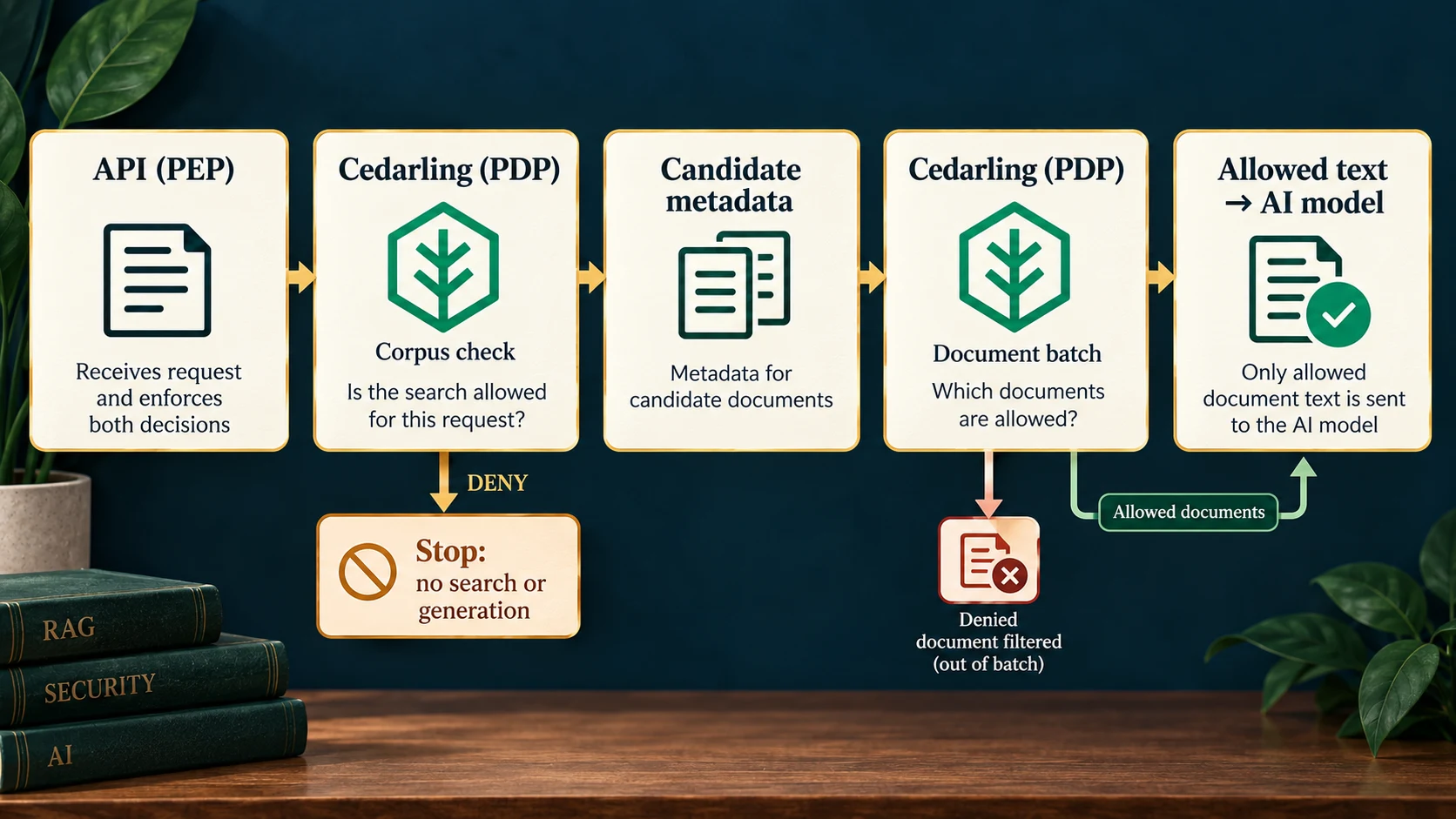
A corpus DENY stops retrieval; a document DENY filters that document from the batch.
Package and load the rules
Install the pinned dependencies from the project directory:
pnpm add --save-exact @janssenproject/cedarling_wasm@0.0.468 fflate@0.8.3
pnpm add --save-dev --save-exact @cedar-policy/cedar-wasm@4.12.0
Add the integration's repository-level shared/policy-store.mjs and
shared/policy-store.d.mts, which are absent from the starting commit. Run the
shared builder to create the archive:
node ../shared/policy-store.mjsIt validates source and generates ignored .local/policy-store.cjar. Docker
uses the same archive source. This helper packages policies; authorization
remains direct Cedarling calls.
In src/authorization.ts, initialize one server instance following the
pinned SDK README (external site).
Here policyStorePath comes from server configuration; this excerpt omits the
surrounding lifecycle code:
// src/authorization.ts
import { readFile } from "node:fs/promises";
import { initFromArchiveBytes } from "@janssenproject/cedarling_wasm";

const archive = new Uint8Array(await readFile(policyStorePath));
const cedarling = await initFromArchiveBytes(
  {
    CEDARLING_APPLICATION_NAME: "P2 TenantRAG server",
    CEDARLING_LOG_TYPE: "memory",
    CEDARLING_LOG_TTL: 300,
    CEDARLING_JWT_SIG_VALIDATION: "enabled",
    CEDARLING_JWT_SIGNATURE_ALGORITHMS_SUPPORTED: ["RS256"],
    CEDARLING_STRICT_SCHEMA_VALIDATION: "enabled",
    CEDARLING_TRUSTED_ISSUER_LOADER_TYPE: "SYNC",
  },
  archive,
);
if (cedarling.loadedTrustedIssuersCount() < 1) {
  await cedarling.shutDown();
  throw new Error("P2 trusted issuer did not load");
}
Start the IdP first. Log the archive version and SHA-256 at startup and call
shutDown() on application closure. src/runtime.ts wires the authorization
functions into the retrieval service.
Authorize the corpus
Inside the corpus authorization function, principal is the authenticated
caller, profile its repository access profile, and corpus the resolved record.
This expanded request shows what the completed tokenSet() and
requestContext() helpers provide:
// src/authorization.ts
const tokens = [
  { mapping: "P2TenantRAG::Access_token", payload: principal.accessToken },
];
const context = {
  boundary: "server",
  user: { subject: principal.id, tenant_id: profile.tenantId },
  selected_corpus_id: corpus.corpusId,
};
const result = await cedarling.authorizeMultiIssuer(
  JSON.stringify({
    tokens,
    action: 'RAG::Action::"SearchCorpus"',
    resource: {
      cedar_entity_mapping: {
        entity_type: "RAG::Corpus",
        id: corpus.corpusId,
      },
      corpus_id: corpus.corpusId,
      tenant_id: corpus.tenantId,
    },
    context,
  }),
);
for (const log of cedarling.getLogsByRequestId(result.request_id)) {
  console.info(JSON.stringify(log, null, 2));
}
if (result.response.diagnostics.errors.length > 0) {
  throw new Error("Cedarling returned policy evaluation errors");
}
return result.decision;
authorizeMultiIssuer() receives a JSON string, so JSON.stringify() turns
the request object into the format expected by the Cedarling JavaScript API.5
The later JSON.stringify(log, null, 2) only formats nested log fields for this
local exercise.
In src/rag/retrieval.ts, call this before voyage.embed() and
corpusSearch.search(). False becomes corpus_not_found, like an unknown
corpus. An unavailable decision stops work with retrieval_unavailable.
Batch document decisions before loading text
Deduplicate resolved candidate documents. In the document authorization function,
reuse the same token set and context and submit one item per document. This
excerpt expands the request assembled in src/authorization.ts:
// src/authorization.ts
const batch = await cedarling.authorizeMultiIssuerBatch(
  JSON.stringify({
    tokens,
    items: documents.map((document) => ({
      action: 'RAG::Action::"RetrieveDocument"',
      resource: {
        cedar_entity_mapping: {
          entity_type: "RAG::Document",
          id: document.documentId,
        },
        corpus_id: document.corpusId,
        tenant_id: document.tenantId,
        classification: document.classification,
        confidential_reader_subjects: document.confidentialReaderSubjects,
      },
      context,
    })),
  }),
);
Require item.is_ok before item.unwrap(), reject diagnostics errors, and collect
actual decisions in submitted order. Print native logs by each result's request
ID. A successful item can contain DENY. An incomplete batch is a failure, not
permission for unchecked documents.
The retrieval service forms an allowed-document set, filters candidates, and
selects at most the requested three chunks. Only then does it call
repository.loadChunkText() and generation. Build citations from those same
chunks, not all search candidates.6
Keep the query bounds, server-selected corpus filter, input validation, and
provider timeouts. The integration also refreshes the synthetic PDFs; after
changing PDFs, rebuild the index with pnpm corpus:reset and restart. Rebuilding
consumes Voyage quota; do not rerun setup or reset just to retry a model response.
Restart after policy edits.
Finish the runnable retrieval stack
With both authorization gates in place, connect archive creation to every startup path. The completed build runs the shared builder before TypeScript; Docker copies the generated archive into the API image.7
{
  "scripts": {
    "build": "node ../shared/policy-store.mjs && tsc -p tsconfig.build.json"
  }
}
Separate cheap preparation from provider-backed corpus setup: scripts/prepare.ts
synchronizes the local IdP/configuration and builds policies without using AI
quota. scripts/preflight.ts refuses startup if the corpus index is missing;
scripts/dev.mjs prepares configuration, then starts the IdP and API. It does
not rebuild the index. Run pnpm run setup once to build the corpus; it also
makes a provider smoke request. Then run pnpm dev. Repeat setup or
pnpm corpus:reset only when the PDF/index needs rebuilding; both consume
Voyage quota.8
The baseline's two-terminal native startup no longer applies to the completed development script.
Prove the evidence boundary, not the model's wording
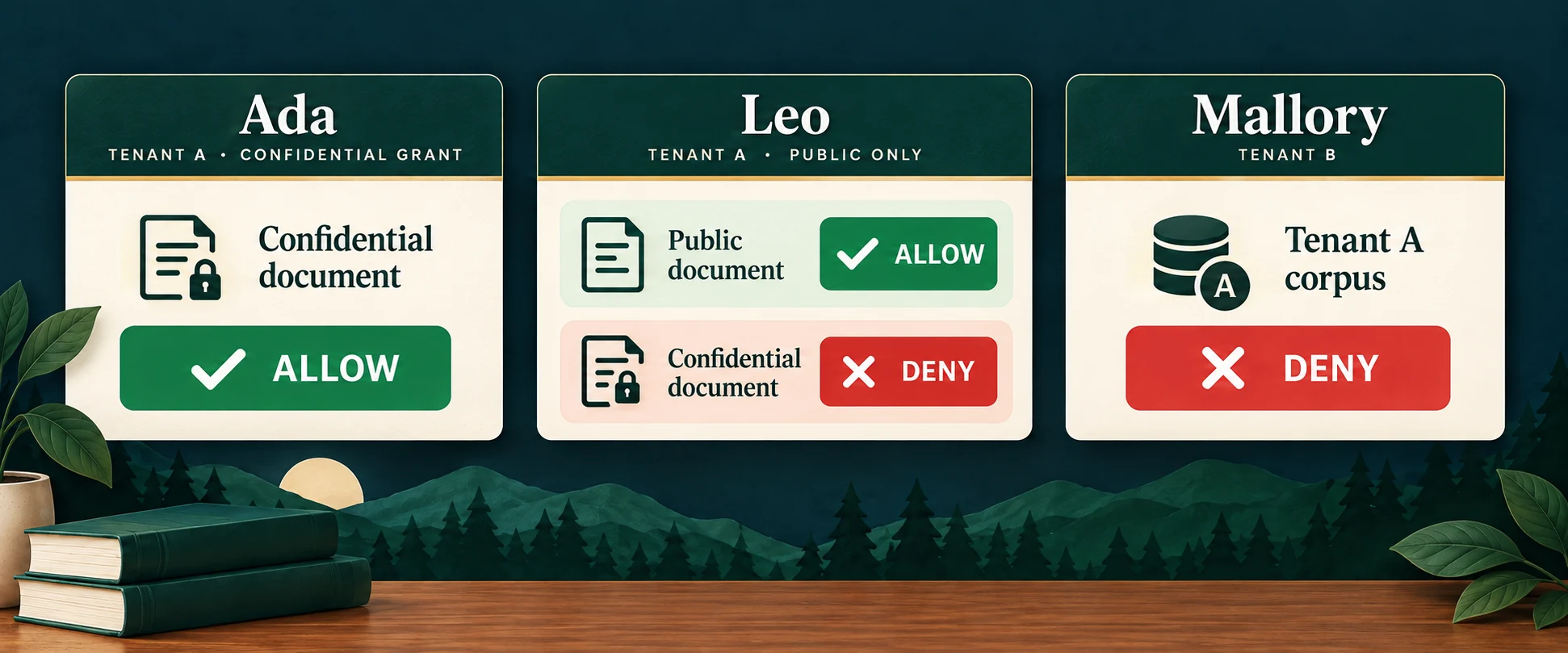
An allowed corpus search does not grant every document inside that corpus.
Repeat the denied request and legitimate work
Repeat Mallory's original request for tenant-a-support. Expect 404 with
error: "corpus_not_found", before embedding, search, or generation. An unknown
corpus has the same status and error code, not a guarantee of identical timing.
Now authenticate as Ada, then Leo, and send:
POST http://localhost:17002/v1/retrievals
Authorization: Bearer <access-token>
Content-Type: application/json

{
  "corpusId": "tenant-a-support",
  "query": "What customer steps and internal corrective actions followed Aster's 12 September support-search interruption?",
  "limit": 3
}
The integrated PDFs describe Aster in Tenant A and Beacon in Tenant B. Ada may use Aster's confidential evidence; Leo may not. Ranking determines candidates, so inspect actual document decisions and citations rather than assuming one fixed answer or candidate order.
| Attempt | Expected outcome |
|---|---|
| Mallory searches Tenant A | Corpus DENY; 404; no remote retrieval work |
Ada retrieves candidate a-confidential |
Document ALLOW |
| Leo retrieves the same candidate | Document DENY; its chunks never load |
| Leo retrieves Tenant A public candidates | ALLOW; generation may use those chunks |
Leo selects tenant-b-support |
Corpus DENY, regardless of the question's wording |
A denied document does not deny the entire question. With no authorized candidate
chunks, expect 200, answer: null, and citations: [], without generation.
A 503 retrieval_unavailable is instead a runtime or provider failure.
With the free OpenRouter model router, availability and answer quality vary;
retry a 503 before treating it as an application defect. A terse answer such as
"User Safety: safe" is not the expected business answer and is not evidence
of authorization. Judge access by Cedarling decisions and citations, not the
model's wording. To try another model, set P2_OPENROUTER_MODEL in .env.
Paid routing requires both a paid model ID and
P2_OPENROUTER_ALLOW_PAID=true; use it only if you intend to spend your
OpenRouter credit. Adding credit alone leaves the configured
openrouter/free router unchanged.
Do not rerun pnpm run setup merely to retry generation: setup also rebuilds
the corpus using Voyage quota.
Explain the logs
The response's requestId appears in authorization.context. Its
cedarlingRequestId matches a native request_id; document decisions also share
batch_id. For Leo's confidential-document attempt, the important native fields
look like this illustrative excerpt:
{
  "log_kind": "Decision",
  "action": "RAG::Action::\"RetrieveDocument\"",
  "resource": "RAG::Document::\"a-confidential\"",
  "decision": "DENY",
  "principal": [],
  "diagnostics": { "reason": [], "errors": [] }
}
Token evidence explains the empty principal array. An empty reason with no errors
means no permit matched, not a list of failed conditions. Compare Leo's subject
with the policy's reader grant. An allowed document names
server-retrieve-authorized-document in its reasons.
retrieval.completed reports candidates, documents evaluated, chunks loaded,
and model. documentAuthorizationCount is not a count of allowed documents.
retrieval.failed names the failed stage; provider failures include bounded
provider details. Failure at answer.generate is not a Cedarling denial.
Capture only synthetic evidence and remove tokens and secrets from recordings.
Check ordering and failures
From the completed project:
pnpm checkThis runs formatting, lint, types, tests, and build without provider keys.
test/policy-store.test.ts evaluates real Cedarling rules with signed test
evidence. test/retrieval.test.ts proves ordering, denied-text exclusion, empty
results, and unavailable or incomplete decisions with deterministic provider
doubles. Those doubles are not an offline application mode.
test/app.test.ts checks request failures, including unsupported content types
returning 400 invalid_retrieval before retrieval runs.
Start the integrated app and run pnpm test:e2e.
Approve the Ada, Leo, and Mallory sign-ins. This consumes provider quota and
checks evidence access, not identical generated prose. Record the same denied
attempt before and after integration, plus one successful authorized search.
Reuse the pattern in your own service
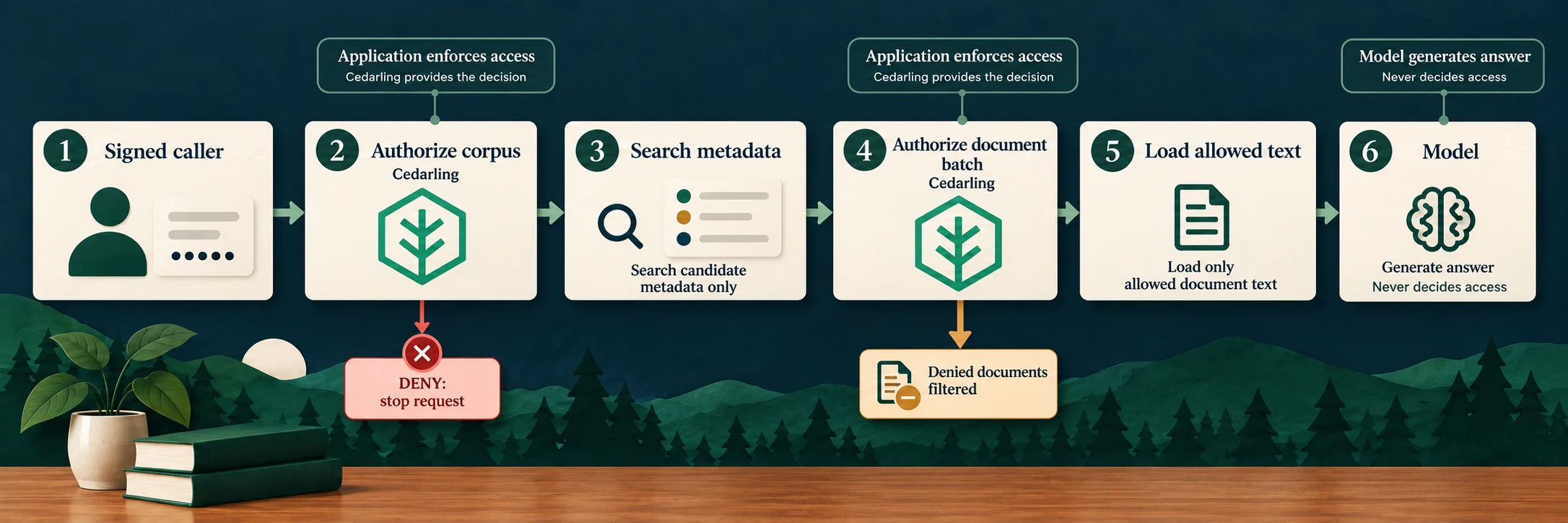
A denied corpus stops the question; a denied document is filtered while other allowed documents may continue.
Authorize the collection before expensive work, then authorize evidence before loading content. Preserve this ordering wherever search results feed a model, report, or another service.
Follow src/authorization.ts, src/rag/retrieval.ts, src/rag/repository.ts,
policy-store/, and the tests in the
completed P2 project (external site).
Production needs real identity and entitlement sources, secure transport, reviewed provider data handling, and protected logs. Setup embeds the synthetic corpus as an ingestion operation, not a caller-authorized retrieval. P2 controls evidence access, not model truthfulness or prompt-injection immunity: an instruction-like public document remains ordinary authorized evidence.
For a production stack, consider Agama Lab Policy Designer for policy authoring, Jans Auth for token issuance, and Lock Server for centralized decision logs. See Cedarling production solutions.
Next, P3 puts authorization at an MCP server, where a model can request a change to incident state as well as information.
Footnotes
-
P2's confidential-reader rule uses the current document's
confidential_reader_subjectsset. Ada's subject is listed; Leo's is not. The application supplies this relationship for each authorization request. ↩ ↩2 -
Starting-checkpoint source:
src/rag/retrieval.ts(external site) marks both permissive seams before embedding and text loading. ↩ -
Completed fact sources:
src/rag/fixtures.ts(external site),src/rag/types.ts(external site),src/rag/pdf.ts(external site), andsrc/rag/repository.ts(external site). ↩ -
Complete tagged store:
metadata.json(external site),schema.cedarschema(external site),server-access.cedar(external site), andtutorial-idp.json(external site). ↩ -
The pinned
cedarling_wasmJavaScript API (external site) accepts a JSON-string request. Serialization changes the data format. ↩ -
Complete enforcement source:
src/authorization.ts(external site),src/rag/retrieval.ts(external site), andsrc/runtime.ts(external site). ↩ -
Archive build and Docker source:
shared/policy-store.mjs(external site),shared/policy-store.d.mts(external site),package.json(external site), andDockerfile(external site). ↩ -
Completed startup files:
scripts/prepare.ts(external site),scripts/preflight.ts(external site),scripts/setup.ts(external site), andscripts/dev.mjs(external site). ↩