




Govern MCP Capabilities with Cedarling
Protect MCP tools, resources, and prompts with signed identity evidence and a private Cedarling sidecar.
On this page
Project source and prerequisites
- Complete P3 project (external site) and starting checkpoint (external site).
- Install Node.js 24.21+ within 24.x, pnpm 10.17.1, and Docker with Compose. Docker is required for the completed P3 stack because Cedarling runs in a containerized Flask sidecar.1 Live chat needs an OpenRouter API key. The pinned sidecar is
linux/amd64, so ARM Docker Desktop needs amd64 emulation. - Local HTTP and the bundled IdP are for learning only. Production requires HTTPS and a configured OIDC/OAuth issuer, such as Jans Auth (external site), Gluu, Auth0, or Okta.
- I prepared these steps on Ubuntu 24.04+. Native project checks also run in CI on macOS and Windows. If a platform-specific step fails, open an issue (external site).
- New to Cedarling? Read the short introduction when you need it.
- Keep the official Cedar policy syntax (external site) and Cedar schema syntax (external site) references handy for the policy-store steps.
Paths are relative to p3-mcp-capability-governance/ unless stated otherwise.
Interactive model availability, tool selection, and wording can vary. A free
provider may be temporarily unavailable; retry the request or choose another
free tool-calling model. If you already have paid OpenRouter credit, you may
explicitly opt in to a paid model. Neither choice changes the MCP server's
authorization rules or makes model output evidence of permission.
What may an incident assistant do for its caller?
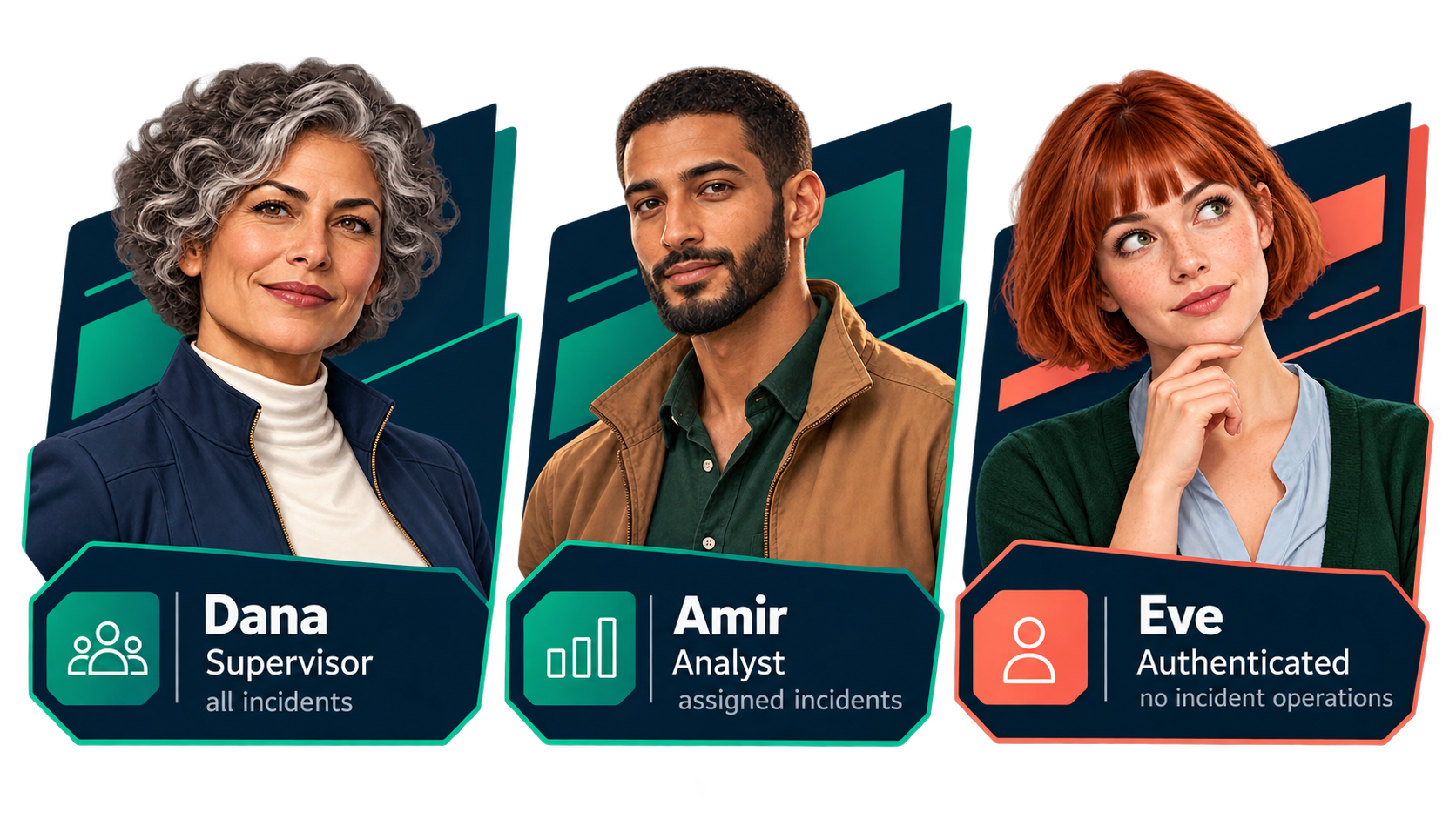
Dana, Amir, and Eve illustrate how role and current assignment affect each MCP operation.
An assistant can choose a valid tool and still request an operation its caller must not perform. Asking “Are you sure?” does not solve that problem. Confirmation expresses intent; authorization establishes permission.
I'll use an incident assistant to show the gap, then protect the operation at the MCP server where it actually takes effect.
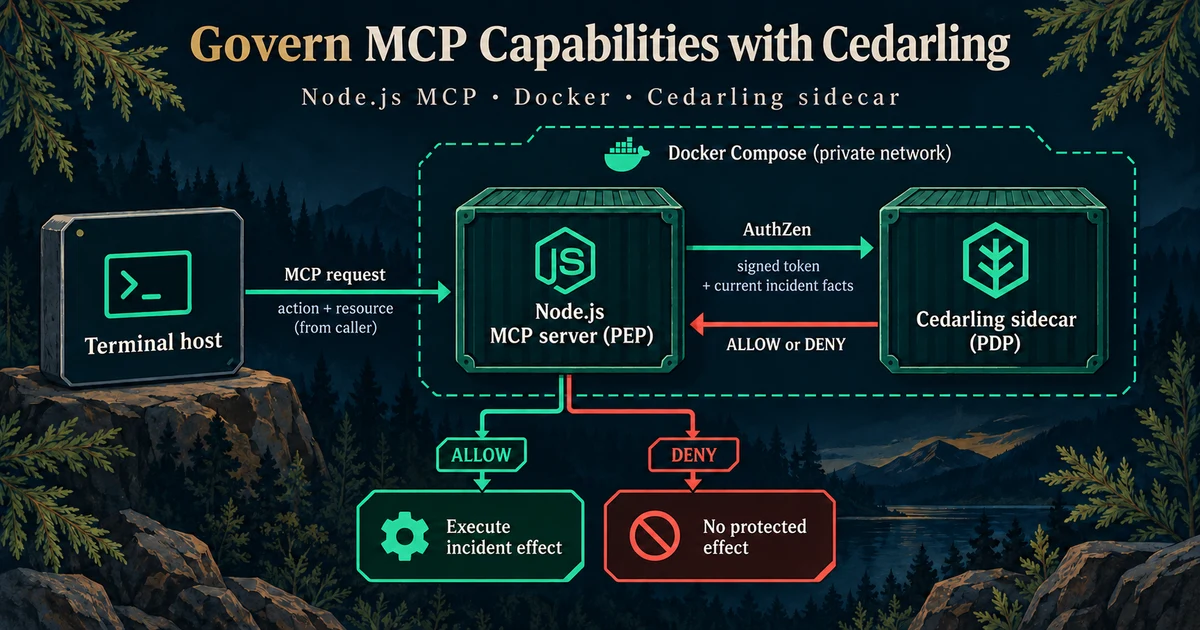
P3 is a terminal assistant backed by a Node.js MCP server.2 It searches incidents, reads a runbook, prepares triage prompts, and advances incident status. We will use Cedarling to protect all three MCP surfaces: tools, resources, and prompts.
- Dana is a supervisor who may operate on every incident.
- Amir is an analyst who may operate only on assigned incidents.
- Eve can authenticate but has no incident-operation authority.
INC-1001 is an open payment incident assigned to Amir. INC-2001 is an
unassigned audit incident in the mitigated state. Amir should not resolve the
second incident merely because the model selected its update tool.
Operator --> terminal host --> OpenRouter selects an operation
                   |
             MCP client + access token
                   |
   local Compose trust boundary
   +---------------------------------------------------------+
   | Node.js MCP server (PEP) --> Cedarling sidecar (PDP)      |
   |       |                       ^                         |
   |       | current caller,       | policy archive          |
   |       | action, resource      | signed token validation |
   |       |                                                 |
   |       +-- ALLOW --> incident / runbook / triage effect    |
   |       +-- DENY or failure --> no protected effect        |
   |                                                         |
   | Tutorial IdP shares this network namespace               |
   +---------------------------------------------------------+
The host and model request work. The MCP server controls the data and effects. Cedarling supplies decisions; it does not invoke tools or update incidents.
Show why authentication and confirmation are insufficient
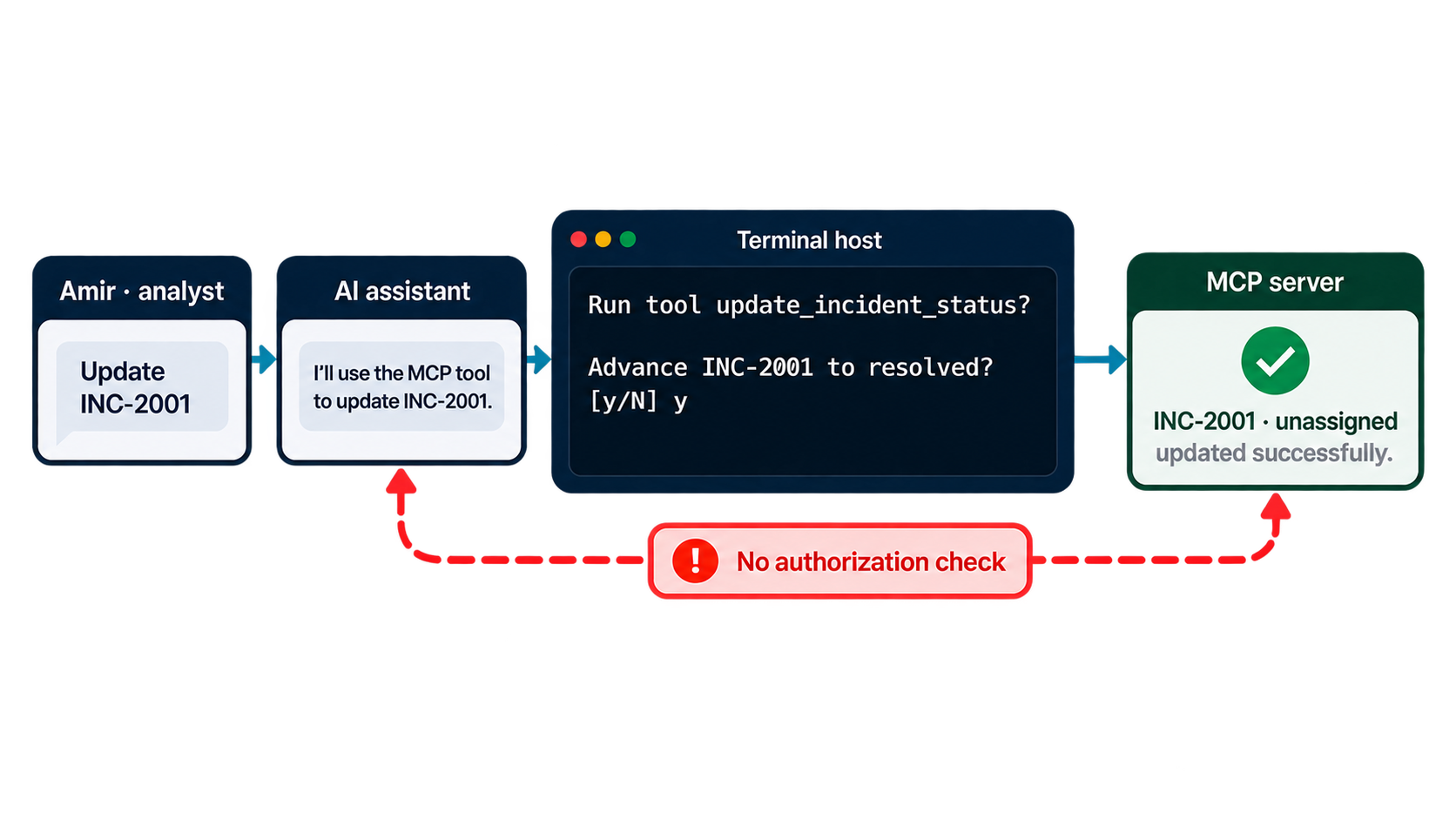
The baseline validates the request but does not yet enforce the assignment rule.
Run the starting application
Use a separate checkout with disposable incident state:
git clone https://github.com/GluuFederation/cedarling-tutorials.git cedarling-p3
cd cedarling-p3
git switch --detach 21b0832be4b31271320df992d04e9d97667d0e38
cd p3-mcp-capability-governance
pnpm install --frozen-lockfile
pnpm run setup
Host commands require Node.js 24.21 or newer within 24.x and pnpm 10.17.1. Start the baseline server and its IdP with Docker Compose:
docker compose up --buildThe MCP endpoint is http://localhost:17003/mcp; the IdP is
http://localhost:18003. Set P3_OPENROUTER_API_KEY in the host project's ignored
.env for interactive chat. In another terminal:
pnpm chat amirOpen the displayed verification URL. The development IdP usually prefills
amir; enter it if the field is empty. Use any non-empty password such as
cedarling-is-awesome, then approve access. Enter these
requests separately:
Find incident INC-2001.
Advance INC-2001 from mitigated to resolved.
Confirm with y when asked. The permissive baseline lets Amir find and change
this unassigned incident. It validates identity, input, confirmation, and the
state transition, but does not enforce the assignment rule.
A free provider may fail before producing an MCP call. Retry or choose another
model; that failure does not show authorization protection. Capture the
unauthorized incident change and note its business impact: an analyst changed
an incident he does not own. Stop
the baseline before running the integrated stack. docker compose down followed
by a fresh start restores P3's in-memory incident fixtures.
Prepare the MCP server for a decision
No separate incident feature needs adding before Cedarling. The baseline already authenticates the MCP caller, validates tool input, asks the terminal user to confirm a status change, and enforces the incident's state transition and idempotency key. In the update handler, a permissive trace sits immediately before the existing mutation:3
// src/mcp/server.ts (starting checkpoint)
const incident = services.incidents.updateStatus({
  incidentId,
  expectedStatus,
  nextStatus,
  idempotencyKey,
});
Keep those application checks. Do not put permission in the chat model or its confirmation prompt. The MCP server will load the current incident and ask the sidecar before this call; discovery, search results, runbook text, and triage prompts need their own gates too.
Define authority for each MCP boundary
We have now seen the authenticated but permissive starting point. From here, we will add Cedarling: first the authority model, then a decision at every MCP boundary, and finally the same unassigned-incident attempt as a comparison.
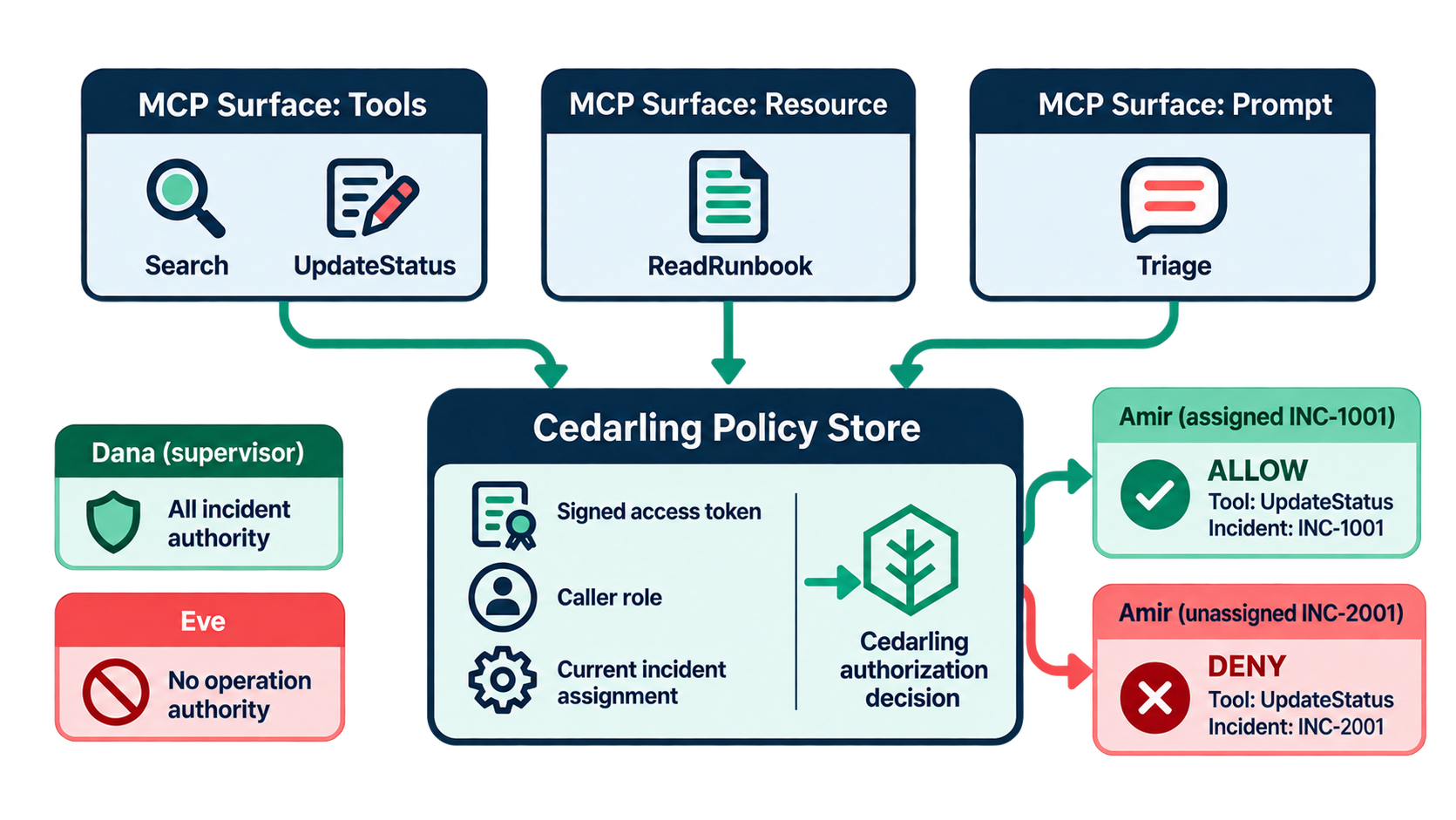
The decision combines trusted identity with facts about the current incident.
Model real resources, not model intentions
The business rule is small: operations staff can discover the service, search, and read guidance; supervisors cover all incidents, while analysts cover only their assignments. Eve receives no operations.
| Capability | Identity | Action | Resource | Trusted context | Protected effect |
|---|---|---|---|---|---|
| Discover | Signed caller token | Discover |
Service::"incident-assistant" |
Current caller subject and role | Register the caller's MCP surface |
| Search | Same token | Search |
Same service | Same caller | Begin incident search |
| Read result | Same token | Read |
Each candidate Incident |
Same caller; assignment on resource | Return a matching incident summary |
| Read runbook | Same token | ReadRunbook |
Runbook::"core" |
Same caller | Return runbook content |
| Prepare triage | Same token | Triage |
Current Incident |
Same caller; assignment on resource | Return an incident-specific prompt |
| Update status | Same token | UpdateStatus |
Current Incident |
Same caller; assignment on resource | Commit one valid transition |
All types and actions use namespace P3IncidentAssistant. The model can nominate
an incident ID; the server loads the incident and its assignment. Role comes from
the server's account profile, not the model or a caller-provided JSON field.
State-transition and idempotency checks remain application responsibilities.
The policy combines a role check with the current incident-to-analyst assignment;
the model's choice of tool or incident is never itself a grant.
Build the policy store
Create the directory-based policy store (external site):
policy-store/
  metadata.json
  schema.cedarschema
  policies/
    incident-operations.cedar
  trusted-issuers/
    tutorial-idp.json
Create these four files from the completed policy store.4
Use the integration's metadata with policy version 1.0.0. The schema defines
Service, Runbook, and Incident; only the incident needs an optional
assigned_to attribute. It also defines Access_token, TrustedIssuer, the
issuer URL shape, and context containing caller and optional generated tokens.
The actions declare the token type in their principal vocabulary; the sidecar
request supplies signed evidence rather than constructing another user entity.
No default entities, templates, or custom issuers are needed. Current account and incident facts are supplied by the MCP server.
For the pinned sidecar, policy-store/trusted-issuers/tutorial-idp.json uses
this exact shape:
{
  "name": "P3IncidentAssistant",
  "description": "Shared Cedarling tutorial identity provider",
  "configuration_endpoint": "http://localhost:18003/.well-known/openid-configuration",
  "token_metadata": {
    "access_token": {
      "trusted": true,
      "entity_type_name": "P3IncidentAssistant::Access_token",
      "token_id": "jti",
      "required_claims": [
        "iss",
        "sub",
        "aud",
        "jti",
        "exp",
        "scope",
        "client_id"
      ]
    }
  }
}
Keep configuration_endpoint as used by this pinned sidecar, rather than copying
another runtime's issuer property name. The MCP authentication middleware verifies
JWT evidence and the coarse mcp.access scope. Policies additionally bind token
subject, API audience, and client ID to this caller and application.
Require identity evidence as well as a business permit
In policies/incident-operations.cedar, a forbid protects every operation if
required signed evidence is missing or mismatched:
// policy-store/policies/incident-operations.cedar
@id("require-p3-access-token")
forbid(principal, action, resource) unless {
  context has tokens &&
  context.tokens has p3incidentassistant_access_token &&
  context.tokens.p3incidentassistant_access_token.hasTag("sub") &&
  context.tokens.p3incidentassistant_access_token.getTag("sub").contains(context.caller.subject) &&
  context.tokens.p3incidentassistant_access_token.hasTag("aud") &&
  context.tokens.p3incidentassistant_access_token.getTag("aud").contains("http://localhost:17003/mcp") &&
  context.tokens.p3incidentassistant_access_token.hasTag("client_id") &&
  context.tokens.p3incidentassistant_access_token.getTag("client_id").contains("p3-mcp-capability-governance-cli")
};
Then grant incident operations only to the appropriate caller:
// policy-store/policies/incident-operations.cedar
@id("incident-assignment")
permit(principal, action in [
  P3IncidentAssistant::Action::"Read",
  P3IncidentAssistant::Action::"UpdateStatus",
  P3IncidentAssistant::Action::"Triage"
], resource is P3IncidentAssistant::Incident) when {
  context.caller.role == "supervisor" ||
  (context.caller.role == "analyst" && resource has assigned_to &&
    resource.assigned_to == context.caller.subject)
};
The remaining operations-surface permit covers Discover, Search, and
ReadRunbook for supervisor or analyst roles. A permit cannot override a matching
forbid, and no matching permit gives DENY. These are
Cedar policy semantics (external site),
not role checks in the chat model.
Enforce the rules at the MCP server
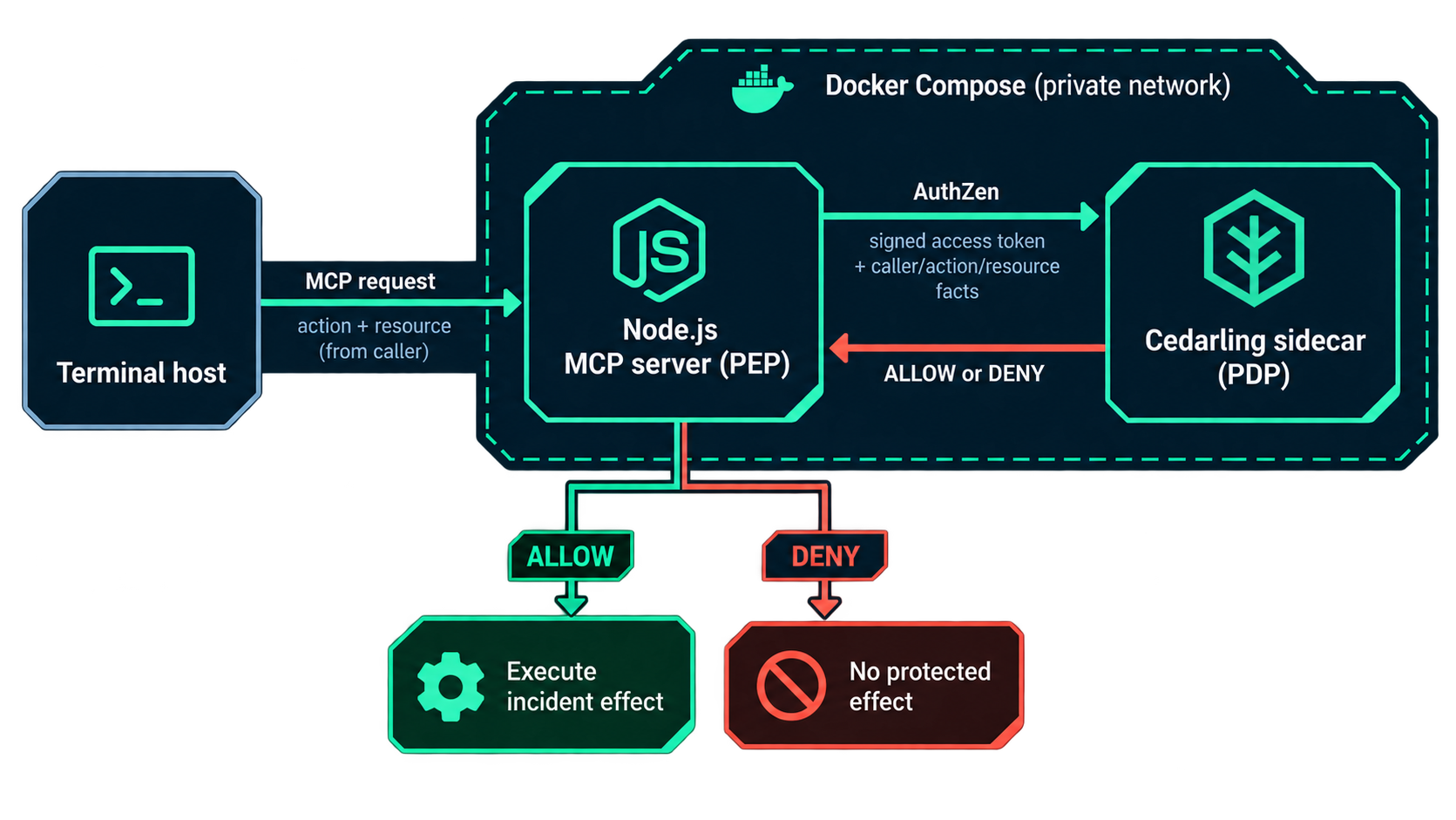
The MCP server is the enforcement point; the sidecar returns authorization decisions.
Run the private sidecar
The Node.js application calls the sidecar's AuthZEN-style HTTP endpoint.5 The policy decision point runs in the Dockerized Flask sidecar, not inside the MCP server; the MCP server remains the enforcement point. Pin the Docker image:
ghcr.io/janssenproject/jans/cedarling-flask-sidecar:2.4.1-1@sha256:501d5bc88e8a0b67cbab314b31c787f94b6c4ad9f16a77ec81d0e183b2645f0bThis image is linux/amd64; ARM Docker Desktop requires amd64 emulation. Add the
integration's shared policy-store.mjs builder and declaration at repository
level, and install its build dependencies from P3:
pnpm add --save-dev --save-exact fflate@0.8.3 @cedar-policy/cedar-wasm@4.12.0
node ../shared/policy-store.mjs
Run the builder before TypeScript compilation. In Dockerfile, use the build
artifact in the policy-store stage; Compose's one-shot policy-store service
places it in a volume mounted read-only by Cedarling. Keep the readable source
in Git and the generated local .cjar ignored.
sidecar-bootstrap.json selects /policy-store/policy-store.cjar, enables JWT
signature and strict schema validation, accepts RS256, and loads issuers
synchronously. Native logs go to standard output. Set
CEDARLING_TOKEN_CACHE_MAX_TTL to 1800, matching the thirty-minute tutorial
tokens. Set SIDECAR_DEBUG_RESPONSE=False in Compose.
Use the integrated compose.yaml topology: the MCP server and Cedarling join the
IdP's network namespace. The sidecar binds 127.0.0.1:5000 there. Only application
port 17003 and IdP port 18003 are published on host loopback. The sidecar is not
published. Wait for the IdP and archive before starting Cedarling, then wait for
Cedarling readiness before starting the MCP server.
JWT validation establishes the request subject; it does not authenticate every service that can reach the sidecar. This local trust boundary includes the IdP. A multi-host production deployment needs authenticated service transport, such as mTLS through a service mesh6 or reverse proxy, as well as network restrictions.
Send current facts directly to the Cedarling sidecar instance
An AuthZEN-style decision request has a subject, action, resource, and context,
and the response contains a boolean decision.5 In this Cedarling sidecar
integration, the subject also carries a signed access token with a named token
mapping, and the resource carries cedar_entity_mapping plus current incident
facts. Those mapping properties and the /cedarling/evaluation path are
Cedarling-specific; do not treat them as generic AuthZEN fields. A valid true
decision allows the MCP server to continue; DENY or an unavailable response
must leave the protected effect untouched.
Place the HTTP call in src/mcp/authorization.ts. The following excerpt belongs
inside the authorization function: auth is verified MCP authentication,
subject is the mapped persona, roles is the server account map, and resource
was loaded by the operation. action is a server-selected action name.
// src/mcp/authorization.ts
const response = await fetch("http://127.0.0.1:5000/cedarling/evaluation", {
  method: "POST",
  headers: { "content-type": "application/json" },
  redirect: "error",
  signal: AbortSignal.timeout(2_000),
  body: JSON.stringify({
    subject: {
      type: "JWT",
      id: subject,
      properties: {
        tokens: [
          { mapping: "P3IncidentAssistant::Access_token", payload: auth.token },
        ],
      },
    },
    action: { name: `P3IncidentAssistant::Action::"${action}"` },
    resource: {
      type: resource.type,
      id: resource.id,
      properties: {
        cedar_entity_mapping: {
          entity_type: `P3IncidentAssistant::${resource.type}`,
          id: resource.id,
        },
        ...(resource.type === "Incident" && resource.assignedTo !== null
          ? { assigned_to: resource.assignedTo }
          : {}),
      },
    },
    context: { caller: { subject, role: roles[subject] } },
  }),
});
JSON.stringify() supplies the HTTP request body as JSON here.7
Reject unsuccessful HTTP responses, malformed bodies, and timeouts. Validate a
boolean decision and object context; this pinned sidecar can report runtime
failure in an HTTP 200 body with context.id === "-1". Treat that as
authorization_unavailable, not an ordinary policy denial. Only a valid true
decision permits the effect. Omit an absent optional assignment rather than
sending null to a string field.
Gate discovery and every operation
In src/mcp/server.ts, evaluate Discover before registering the caller's
operations. A denied caller receives valid empty discovery. Registering a tool
is not permission to use it against every resource.
- Search requires
Search, then checksReadfor each candidate incident before returning it. Apply the requested result limit after authorization filtering. - Runbook reads require
ReadRunbookbefore returning text. - Triage requires
Triageon the resolved incident before producing its prompt. - Status updates require
UpdateStatusbefore the repository mutation.
The update boundary looks like this inside its existing handler:
// src/mcp/server.ts
const current = currentIncident(incidentId);
await requireAllowed("UpdateStatus", {
  type: "Incident",
  id: current.id,
  assignedTo: current.assignedTo,
});
const incident = services.incidents.updateStatus({
  incidentId,
  expectedStatus,
  nextStatus,
  idempotencyKey,
});
requireAllowed throws on DENY; unavailable decisions also stop execution.
The repository still enforces one-step transitions, current status, and
idempotency synchronously at the effect. A stale state is not made valid by
an earlier ALLOW.
The terminal host owns confirmation and its idempotency key. A model-provided
confirmed value cannot replace the user's confirmation. OAuth credentials never
enter model messages. Model interpretation is not an authorization guarantee.8
Finish the runnable MCP stack
Package the policy archive before TypeScript compilation and make the Docker policy-store stage supply that archive to the private sidecar. The Compose services and readiness order above are part of the completed runtime, not a second authorization path.9
{
  "scripts": {
    "build": "node ../shared/policy-store.mjs && tsc -p tsconfig.build.json"
  }
}
The host scripts/setup.mjs prepares chat configuration; Compose's configure
service prepares the container IdP configuration. Do not make host setup rewrite
that container's issuer. pnpm dev now runs docker compose up --build, while
pnpm chat amir remains a host command. For unrelated greetings, the completed
host asks the model for no operation and returns bounded help without calling
the MCP server. This improves the exercise but is not an authorization rule.10
Prove allowed work and blocked bypasses
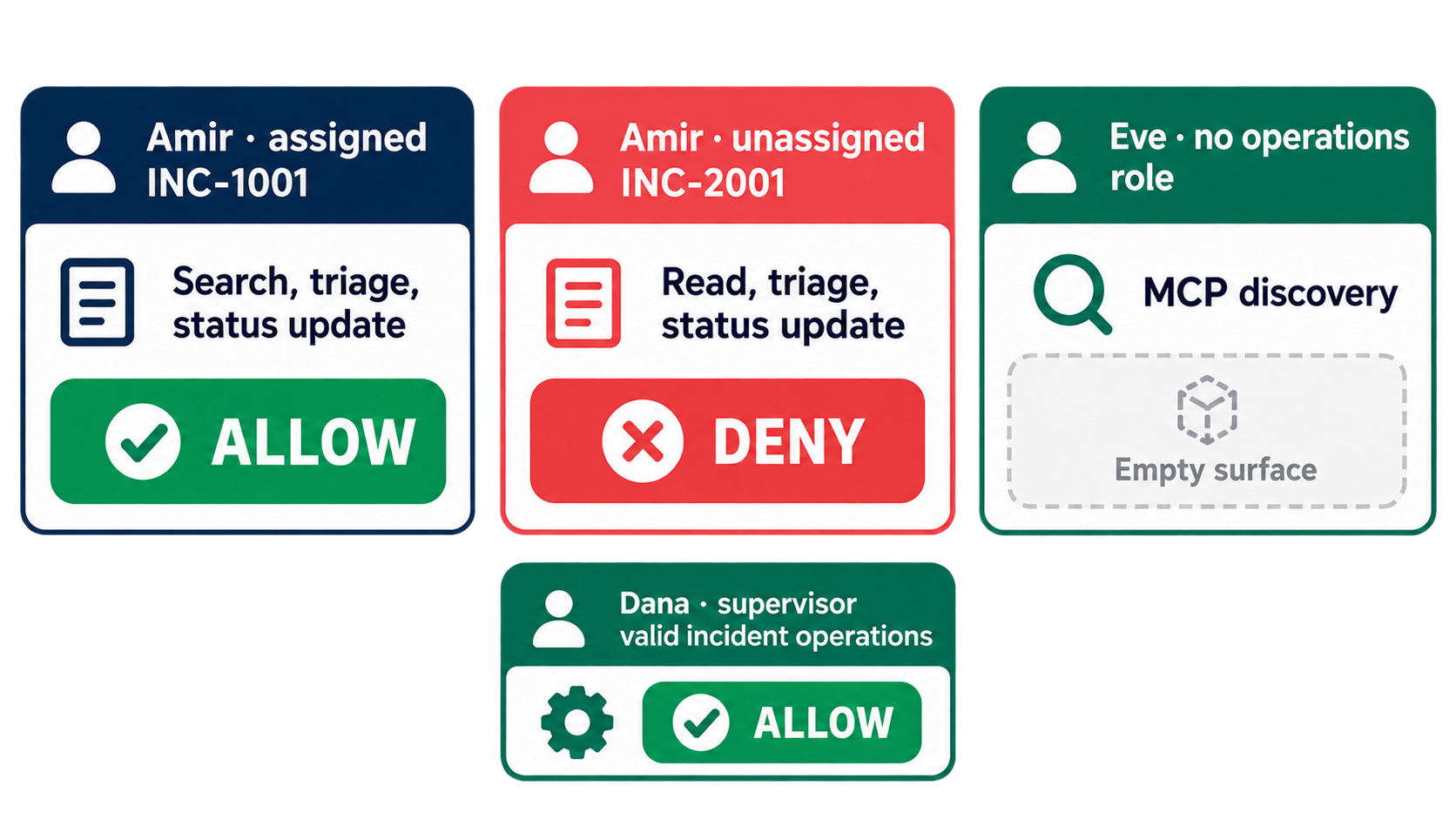
An assigned incident and an unassigned incident produce different decisions for Amir.
Exercise the completed stack
Start the integrated services with docker compose up --build. On the host,
run pnpm install --frozen-lockfile and pnpm run setup, then set
P3_OPENROUTER_API_KEY in .env and run pnpm chat amir.
The completed client defaults to liquid/lfm-2.5-2.6b:free with zero-price
routing. To try another free tool-calling model, set P3_OPENROUTER_MODEL in
.env. A paid model requires both a paid model ID and
P3_OPENROUTER_ALLOW_PAID=true; do this only if you intend to use your paid
credit. Model answers and tool choices can differ even when the authorization
result is the same. The provider may retain prompts for training; use only
fictional incident data.
On fresh fixtures, enter separately:
Find incident INC-1001.
Read the incident response runbook.
Prepare triage for INC-1001.
Advance INC-1001 from open to investigating.
Confirm only the intended update with y. Find the incident again to verify its
new status. Declining confirmation must leave it unchanged.
Now repeat Amir's baseline attempt on INC-2001. Search returns no matching
incident. Triage or update attempts are denied; its mitigated state is unchanged.
Use the following controls:
| Caller and attempt | Expected outcome |
|---|---|
Dana reads or advances INC-2001 |
ALLOW, subject to its current valid transition |
Amir reads or advances assigned INC-1001 |
ALLOW, subject to confirmation and state checks |
Amir triages or updates unassigned INC-2001 |
DENY |
| Eve discovers operations | Empty surface; host does not call the model |
| Direct unauthorized MCP invocation | No protected content or mutation |
| Sidecar timeout or malformed decision | Unavailable; no protected effect |
A free-model error before tool selection is not a policy denial. Retry or use another model; never change access policy to compensate for a generation failure.
Explain the two kinds of decision logs
The MCP server prints formatted authorization.decision records with
requestId, actorId, action, resource, and ALLOW or DENY. One application
request can perform both discovery and an operation, producing several decisions.
Repeated discovery is expected for this stateless MCP surface.
Cedarling's native sidecar records contain policy-store identity and
diagnostics.reason. An allowed assigned-incident action cites
incident-assignment. An unauthorized assignment can produce DENY with no
matching permit and an empty reason; an identity-binding forbid can instead
appear as a determining policy.
Application IDs and native sidecar request IDs are separate in this integration.
Do not present them as an exact join. For a teaching capture, run one operation
at a time and compare actor/action/resource, sequence, and policy reasons.
Verify the returned incident state as well: an ALLOW is not proof of a mutation.
authorization.failed distinguishes transport/runtime failure from policy denial
without printing tokens or raw upstream error bodies.
Check the protected effect, not the assistant's wording
Keep a before-and-after capture of Amir's attempt to resolve unassigned
INC-2001, plus a successful update to assigned INC-1001. A denial matters
only when the incident remains unchanged. An MCP client with a valid Amir token
must not be able to bypass this by calling update_incident_status directly
with incidentId: "INC-2001", expectedStatus: "mitigated", and
nextStatus: "resolved"; the same server-side gate handles direct and
model-selected calls.
For an unavailable-decision exercise, stop only the tutorial sidecar with
docker compose stop cedarling, then attempt an otherwise permitted operation.
The server must report authorization unavailable and leave the incident
unchanged. Restore it with docker compose start cedarling. Restart the learner
stack to restore fixtures between runs; do not treat a resolved incident as a
fresh mitigated fixture.
Apply the same rule to other agent tools
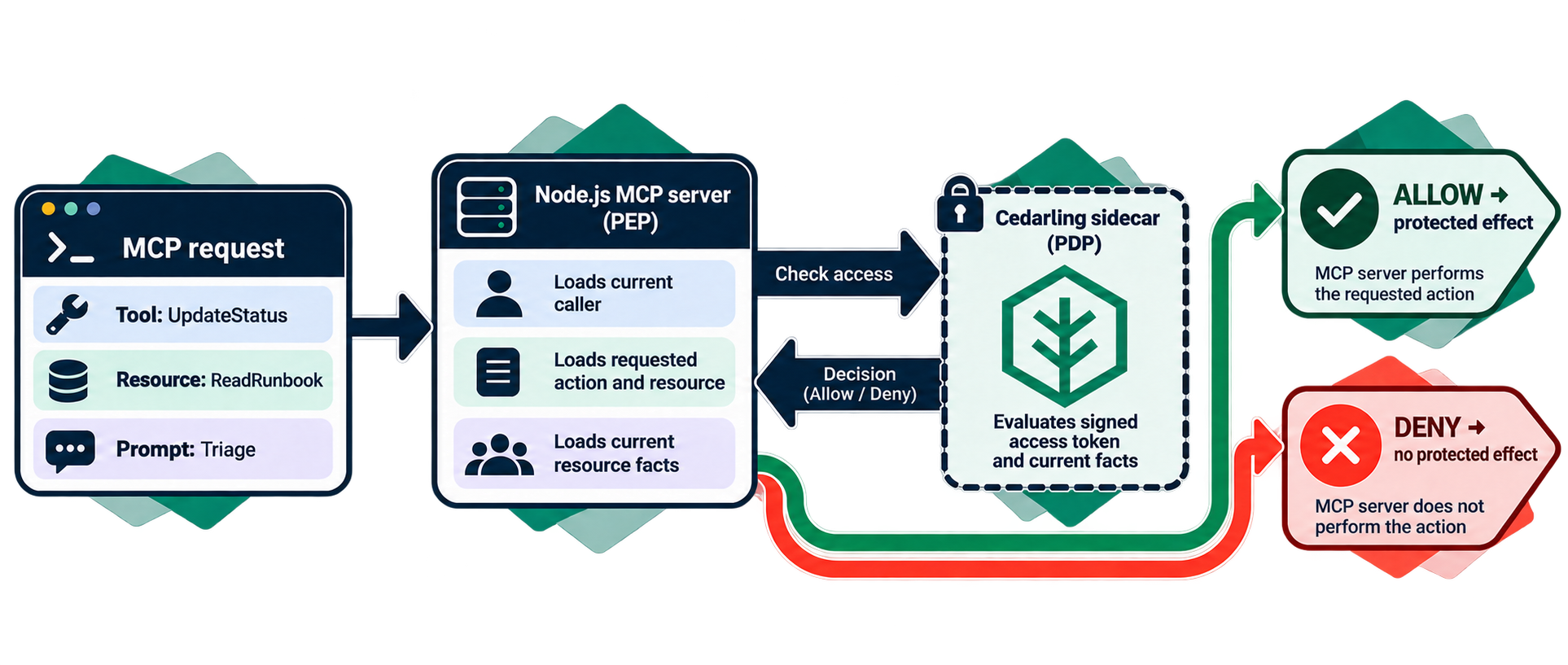
Protect MCP discovery and execution at the server boundary, not in the model.
The component controlling the protected effect must authorize it, even when an agent selected the operation and the user confirmed it. Cover discovery, resources, and prompts as well as mutation tools.
Trace src/mcp/authorization.ts, src/mcp/server.ts,
src/incidents/repository.ts, policy-store/, and compose.yaml in the
completed P3 project (external site).
Production needs persistent incident storage, real account authority, secure service transport, protected credentials, and appropriate log retention. This lab has a development IdP, static account assignments, in-memory incidents, and an optional free-provider chat experience; none is a production availability promise.
For a production stack, consider Agama Lab Policy Designer for policy authoring, Jans Auth for token issuance, and Lock Server for centralized decision logs. See Cedarling production solutions.
Next, P4 asks a related question about human workflows: may a publisher still rely on an approval after the content or reviewer's authority has changed?
Footnotes
-
A Cedarling sidecar (external site) is a separate service that exposes Cedarling decisions to the application over HTTP. In P3, Docker Compose runs that service beside the MCP server. ↩
-
MCP (Model Context Protocol) (external site) lets a client discover and invoke server tools and access resources or prompts. P3 authorizes the server-controlled operation, not the model's wording. ↩
-
Starting-checkpoint source:
src/mcp/server.ts(external site) reloads the incident, prints a permissive trace, then callsupdateStatus();src/incidents/repository.ts(external site) owns the transition and idempotency checks. ↩ -
Complete tagged store:
metadata.json(external site),schema.cedarschema(external site),incident-operations.cedar(external site), andtutorial-idp.json(external site). ↩ -
The OpenID AuthZEN Authorization API (external site) defines the decision request's subject, action, resource, and context and the response's decision. P3 uses the Cedarling sidecar's own endpoint and token/entity mapping fields to implement this pattern. ↩ ↩2
-
Mutual TLS (mTLS) (external site) authenticates both ends of a service connection. A service mesh can manage that transport between application and policy decision service; the local tutorial uses a private shared network namespace instead. ↩
-
Here
JSON.stringify()creates the JSON body for an HTTP POST to the Cedarling sidecar. P3 uses the sidecar's AuthZen endpoint, not thecedarling_wasmJavaScript authorization method. ↩ -
Complete MCP enforcement:
src/mcp/authorization.ts(external site),src/mcp/server.ts(external site), andsrc/incidents/repository.ts(external site). ↩ -
Archive and private sidecar packaging:
shared/policy-store.mjs(external site),package.json(external site),Dockerfile(external site),compose.yaml(external site), andsidecar-bootstrap.json(external site). ↩ -
Host-only setup and no-operation handling:
scripts/setup.mjs(external site),src/chat/host.ts(external site), andsrc/config/project-config.ts(external site). ↩